
Diagnosis · Updated 24 August 2026
Why datingwithmads' TikTok slideshow was a 27× outlier
A datingwithmads TikTok slideshow reached 27× the creator's median. Compare its two-slide reveal with ordinary posts before naming the cause.
This two-slide dating post worked because the setup and screenshot form one unusually tight joke, not because two slides or the opening line are reliable formulas. A live same-account sample puts it at 30.15 times the median, then supplies the awkward evidence: the same opening and format also produced ordinary posts.
The result is real. The easy explanation is not.
This is an independent case study of public third-party content, not a reels.chat campaign or customer result. reels.chat did not create or publish the content and has no private campaign analytics for it.
The TikTok slideshow outlier survived the first check
An X post from @consumerxai described the case as 16.9 million views at 27 times the account median. That was a useful lead, not the finished analysis.
On 24 August 2026, TikHub recorded 17,124,319 plays, 3,354,636 likes, 6,245 comments, 348,292 shares, and 149,753 saves on the cited photo post. It was published on 15 February with two images and the caption #pov #dating #situationship #toxic #pureapp.
The account had 55,333 followers in the same research snapshot.
The latest feed request returned 36 photo posts spanning 4 February to 16 August. Their median was 567,941.5 plays. On that defined window, the cited post was a 30.15× outlier.
That does not prove Handler’s earlier 27× calculation wrong. We do not have its exact snapshot, window, or inclusion rules. It means we should stop borrowing the headline and state the denominator we can reproduce.
Six photo posts, one creator, one repeated format
The baseline is the 567,941.5-play median of 36 latest photo posts returned on 24 August 2026.
Creator-relative breakouts
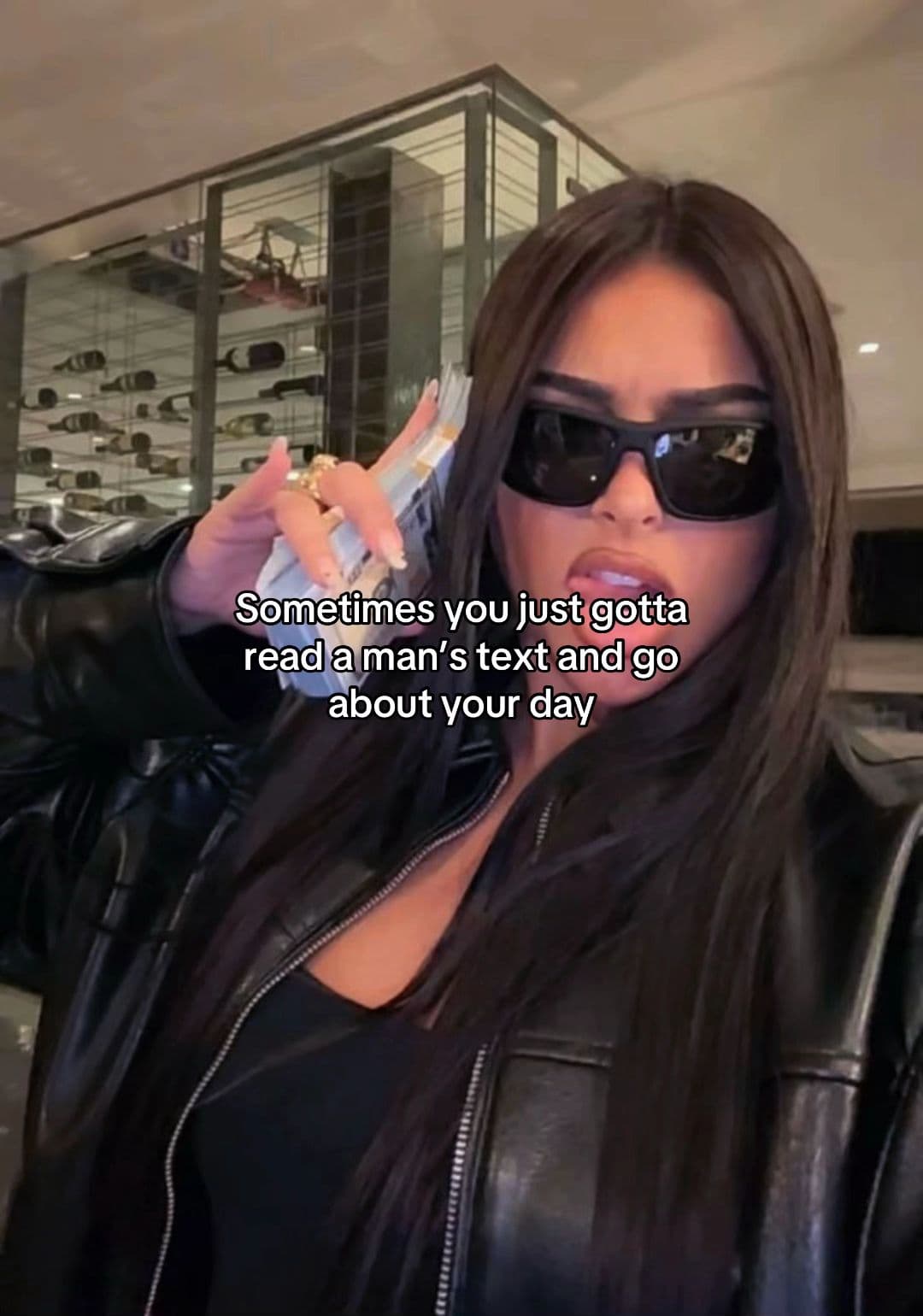

Read a man’s text and go about your day; the second slide reveals the reply.

Traumatise these men back; another two-slide post reached almost the same result.
Matched ordinary controls

The same read-a-man’s-text opening as the cited post, with an ordinary result.

The repeated traumatise-these-men-back opening, close to the account median.

Another traumatise-these-men-back two-slide post, below the median.

The same repeated opening and two-slide format, again below the median.
The evidence cards show the result and the controls together. Counts are public snapshots, not retention or conversion data. The hot feed was also pulled, but it is a winner list and was not used as the baseline.
One X explainer is not prevalence. It found one case worth investigating.
The beat sheet is only two slides long
Photo posts do not have timed video beats, so the slides are the beats.
- Recognition: a selfie carries the line, “Sometimes you just gotta read a man’s text and go about your day.”
- Action: the viewer swipes to see the text that supposedly deserves no further reaction.
- Reversal: the screenshot reveals someone saying, “im seeing someone else.”
- Payoff: instead of hurt or confrontation, the reply escalates to “Fuck it make a group chat / So I can meet my boyfriend in law.”
The opening sounds calm. The screenshot proves the calm is a performance. That contrast is the joke.
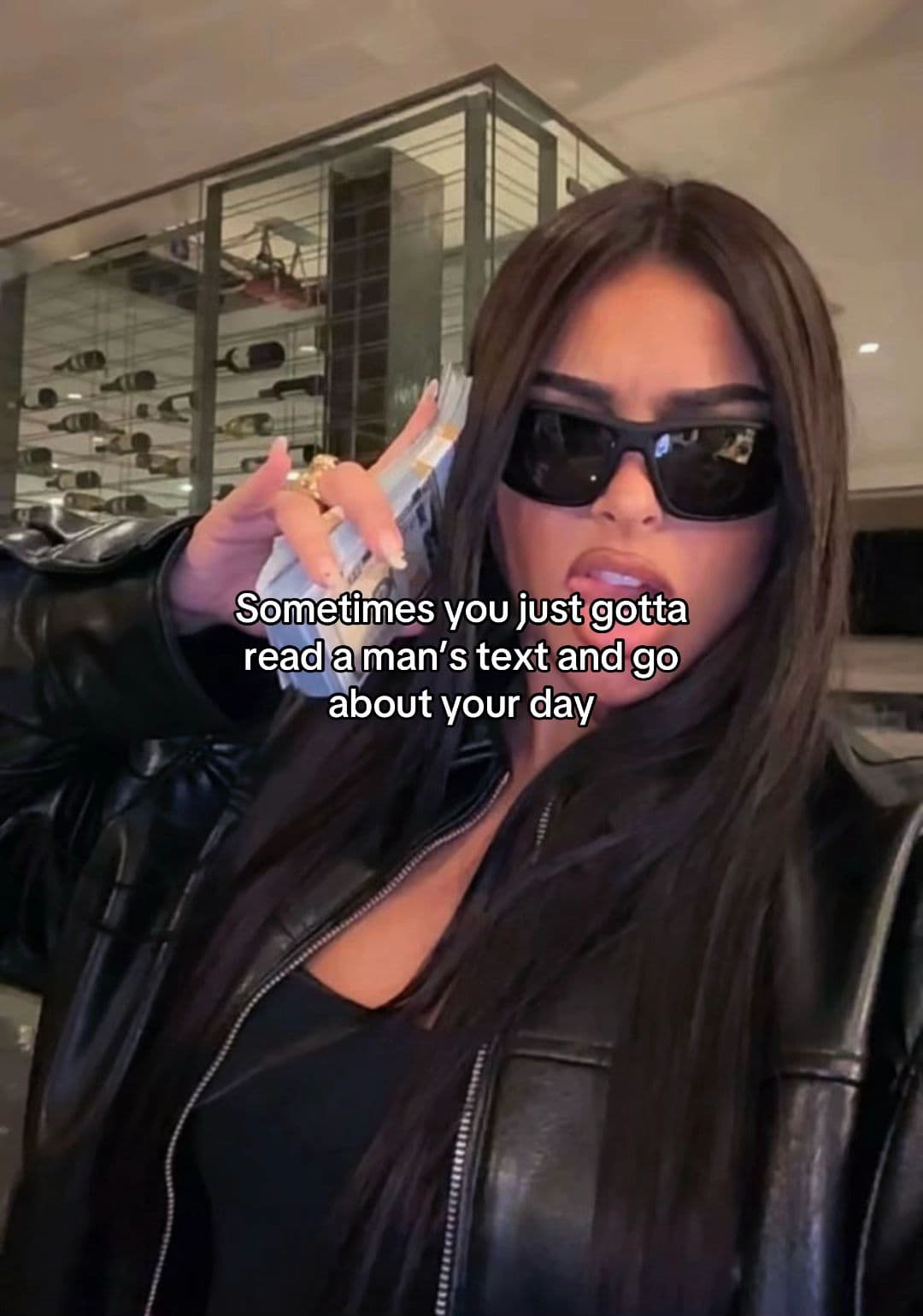
Slide 1 of 2, captured from TikTok on 24 August 2026. The opening withholds the text message and promises a reaction.
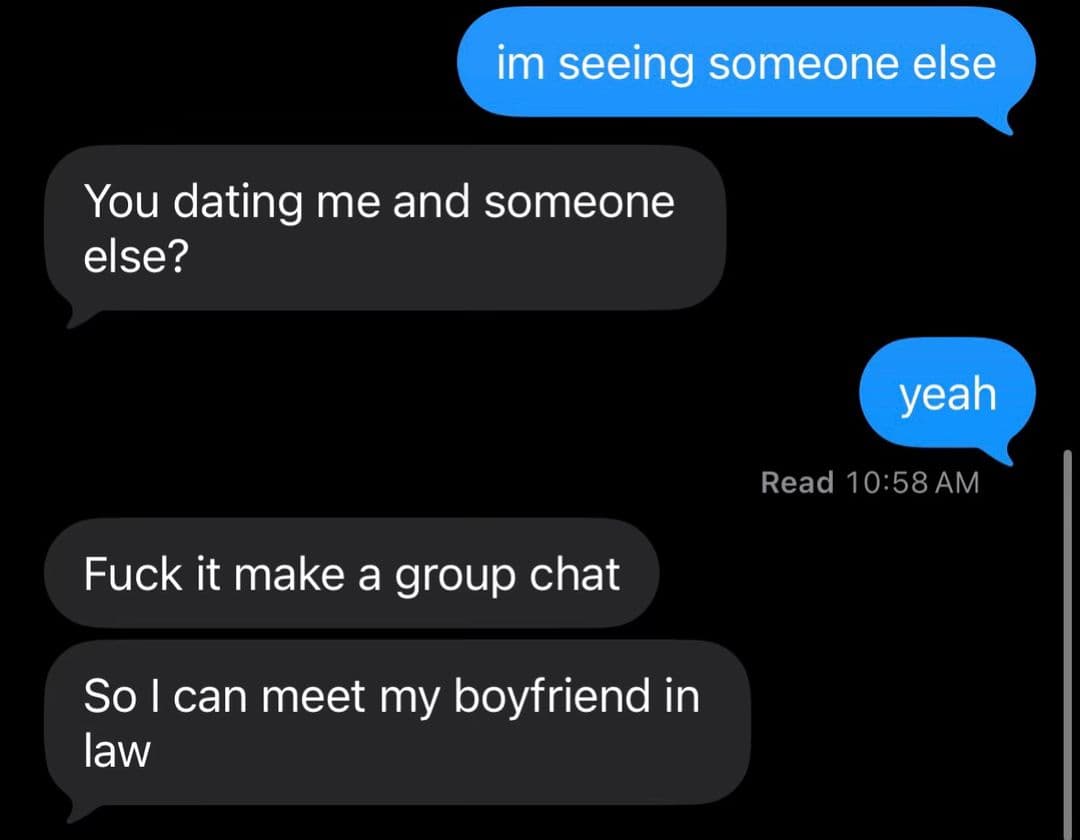
Slide 2 of 2, captured from TikTok on 24 August 2026. The screenshot supplies the betrayal, then converts it into a specific deadpan comeback.
The sequence has no spare beat. Slide one cannot finish the story because the message is missing. Slide two cannot land without the composed pose and “go about your day” instruction first.
That gives us three plausible causes: the opening, the compressed format, and the relationship between topic and proof. Each needs a different test.
| Possible cause | What the public evidence supports | What a reader could test |
|---|---|---|
| Opening | The same first-slide line appeared in both breakout and ordinary posts from the account, so the sentence was not sufficient | Keep the screenshot and two-slide structure close; vary only the first-slide promise |
| Format | Two slides compress setup and punchline, but ordinary two-slide posts show that brevity alone did not produce reach | Retell one scenario in two slides and a longer useful sequence |
| Topic–proof loop | The breakout screenshot delivers a self-contained reversal after the setup, while weaker replicas supplied less distinctive proof | Keep the opening shape; vary the message, reversal, or proof on slide two |
Cause 1: the opening creates a missing object
“Read a man’s text” names the thing we are not allowed to see yet. The line also gives the viewer a small social puzzle: what could he have sent, and how did she really respond?
That is more useful than calling the opening “relatable.” Relatable is usually where analysis goes for a little lie-down. The missing message gives the swipe a job.
But the same-account control is unusually clean. One ordinary two-slide post uses the exact line, “Sometimes you just gotta read a man’s text and go about your day.” It had 462,581 plays, or 0.81 times the sampled median.
The wording was therefore not sufficient. The person, pose, visual polish, date, screenshot, and distribution may differ, so this is not a controlled experiment. It is still enough to falsify “use this hook and get the result.”
Another repeated opening strengthens the finding. “Sometimes you just gotta traumatise these men back” appears on a two-slide post at 16,676,471 plays. The same line also appears on controls at 673,302, 452,349, and 288,578 plays.
One opening lived at both ends of the account’s distribution. Copying it would reproduce the sentence, not the reason to continue.
Test the opening
Start with one screenshot whose second message already works. Make several first slides that create materially different reasons to swipe: a missing message, an unresolved identity, or an apparent rule about dating. Keep the image treatment and second slide stable.
Judge each version against the same account window. If the missing-message versions repeatedly separate, the opening hypothesis gets stronger. One winner does not settle it.
Cause 2: two slides compress the turn
This post asks for one swipe. There is no middle section where the setup can leak energy.
That makes the format a plausible contributor. It does not make two slides causal. Every post in the evidence row uses two slides, including the controls below the median and the other 16.7 million-play breakout.
The account is useful precisely because the format barely changes while outcomes do. The sampled median covers 36 photo posts, and most of the visible comparison set repeats a selfie-plus-reveal structure. A container used at 288,578 and 17.1 million plays cannot explain the difference by itself.
The better format hypothesis is compressed setup and payoff. Two slides help when slide two can finish the promise immediately. They are less useful when the reveal is predictable, generic, or unrelated to what slide one withheld.
Test the format
Take one dating exchange and make two honest versions:
- A two-slide version: setup, then full reveal.
- A longer version: setup, evidence that changes the interpretation, then reveal.
Do not stretch one screenshot across four slides. That tests the audience’s patience, which is a different experiment and perhaps an unnecessary one.
Cause 3: the screenshot earns the swipe
The first slide offers a familiar attitude: see the disappointing message, stay composed, move on. Slide two does not merely show disappointment. It delivers a complete exchange with a specific reversal.
The grey sender misunderstands “I’m seeing someone else” as simultaneous dating, then asks to meet his “boyfriend in law.” That line changes the setup from generic relationship advice into a joke that can be understood and passed on without more context.
This is the topic–proof loop. The topic supplies the tension. The screenshot supplies the evidence and payoff.
The public counters cannot tell us whether viewers completed the slideshow, shared it because of the final line, or arrived through paid distribution. The #pureapp tag identifies product context; it does not prove the app caused reach. Shares are observed. The reason for those shares is not.
Test the proof
Code the job of slide two before publishing. Does it repeat, explain, prove, reveal, or reverse the opening?
Then keep the first-slide structure close and vary the screenshot. A vague bad-date message tests differently from a line with a complete reversal. If specific reversals separate from generic screenshots across several posts, the topic–proof hypothesis gains support.
Several causes probably worked together
The strongest diagnosis is an interaction:
- The opening names a missing text and gives the swipe a purpose.
- Two slides deliver the answer with almost no commitment.
- The screenshot contains a self-contained reversal rather than generic “toxic dating” proof.
The controls stop us from promoting any one of those into a law. The exact cited opening also stayed ordinary. The repeated alternative opening produced both a near-equal breakout and several ordinary results. The two-slide format covered all of them.
Timing, audience history, visual choice, and distribution remain possible causes. We do not have controlled retention or conversion evidence, so assigning percentages would be decoration.
What this case study suggests testing
If you want to test the mechanism on your own content, take the test design rather than the sentence.
- Start with a message or dating moment that has a real turn.
- Write the second slide first, so the proof exists before the opening promises it.
- Draft different first-slide reasons to reveal that same proof.
- Use two slides only when one swipe completes the idea.
- Compare the result with ordinary posts from the same account and state the window.
The parent diagnosis method is deliberately less glamorous: define the symptom, list different causes, find controls, and change the smallest thing that tests one cause. A gym-app two-slide uses the same container in why the Stronger “he hates me” 2-slide worked.
This case earns attention because 17.1 million plays was 30.15 times the measured same-account median. It earns a useful conclusion because the controls killed the hook-list version. The post did not win through a sentence or a slide count in isolation. The setup gave one swipe a job, and the screenshot made that swipe worth it.
Keep reading
Diagnosis
TikTok hold rate: when the hook works but viewers leave
Diagnose a weak TikTok hold rate after the hook by checking the promise, pacing, audience fit, and the exact retention metric you are reading.
Diagnosis
Why this CareSkin before-and-after TikTok slideshow worked
A 12.5M CareSkin before-and-after TikTok slideshow mixed an acne glow-up, an app reveal, and product proof. See what the evidence supports.
Diagnosis
Why this Costco snack-list TikTok slideshow worked
A 9.6M Costco snack-list TikTok slideshow put a useful list before the app reveal. See which parts of the app-marketing format are worth testing.